The first ever photobook was made by a woman. A wonderful sentence to read, isn’t it? It took a few years (over 100) for her to get the recognition she deserves but now Anna Atkins is widely known as the creator of the world’s first photographically illustrated book.
Publisher
Anna Atkins
Date / Origin
October 1843, Halstead Place, Sevenoaks, England
Price
Priceless
Raised by her father — a chemist, mineralogist, and zoologist — she received an unusually thorough scientific education for a woman of her time, and from an early age was actively involved in his research, illustrating his publications and engaging directly with the natural sciences. This foundation, rare amongst women of her generation, shaped both her intellectual rigour and her visual sensibility.
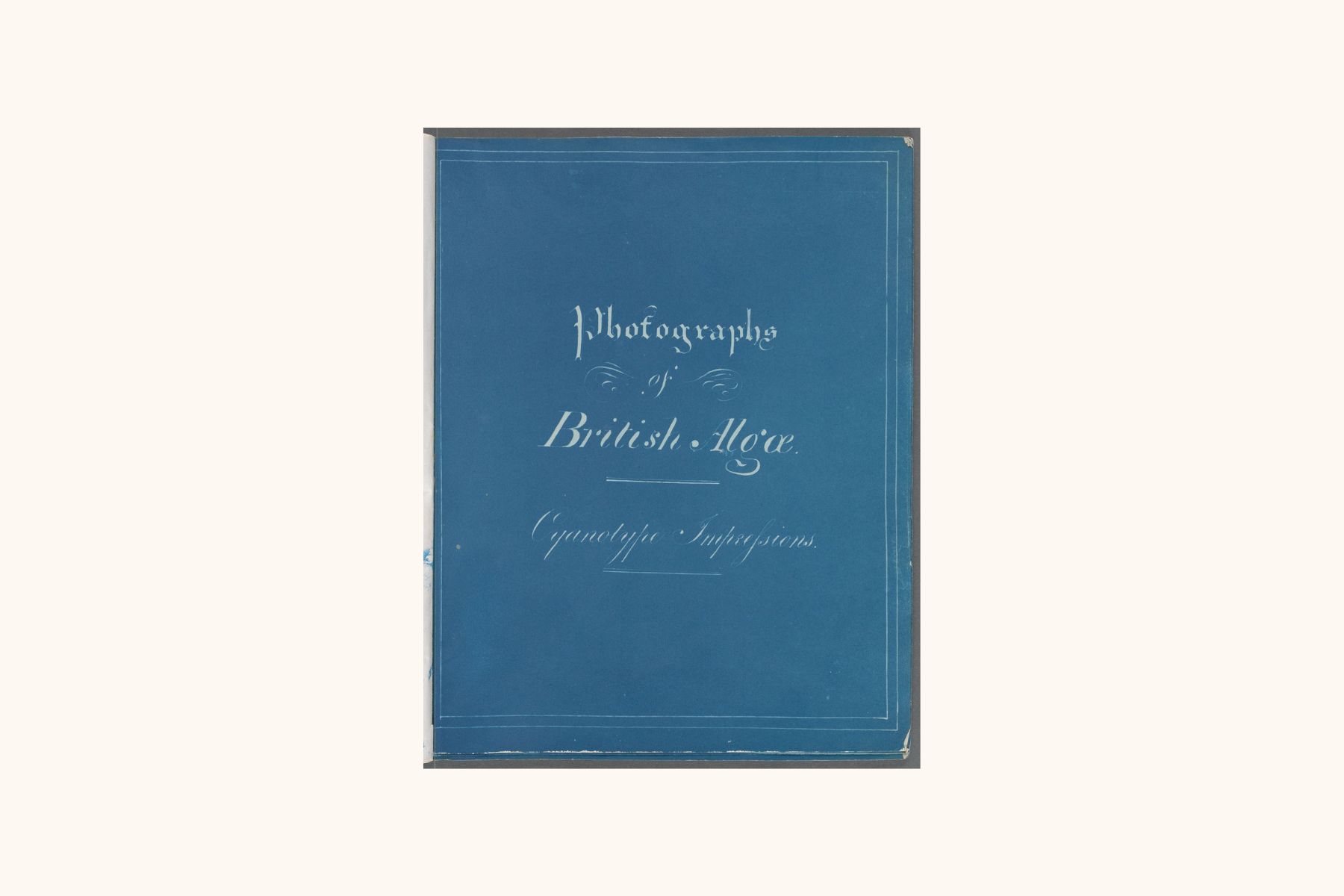
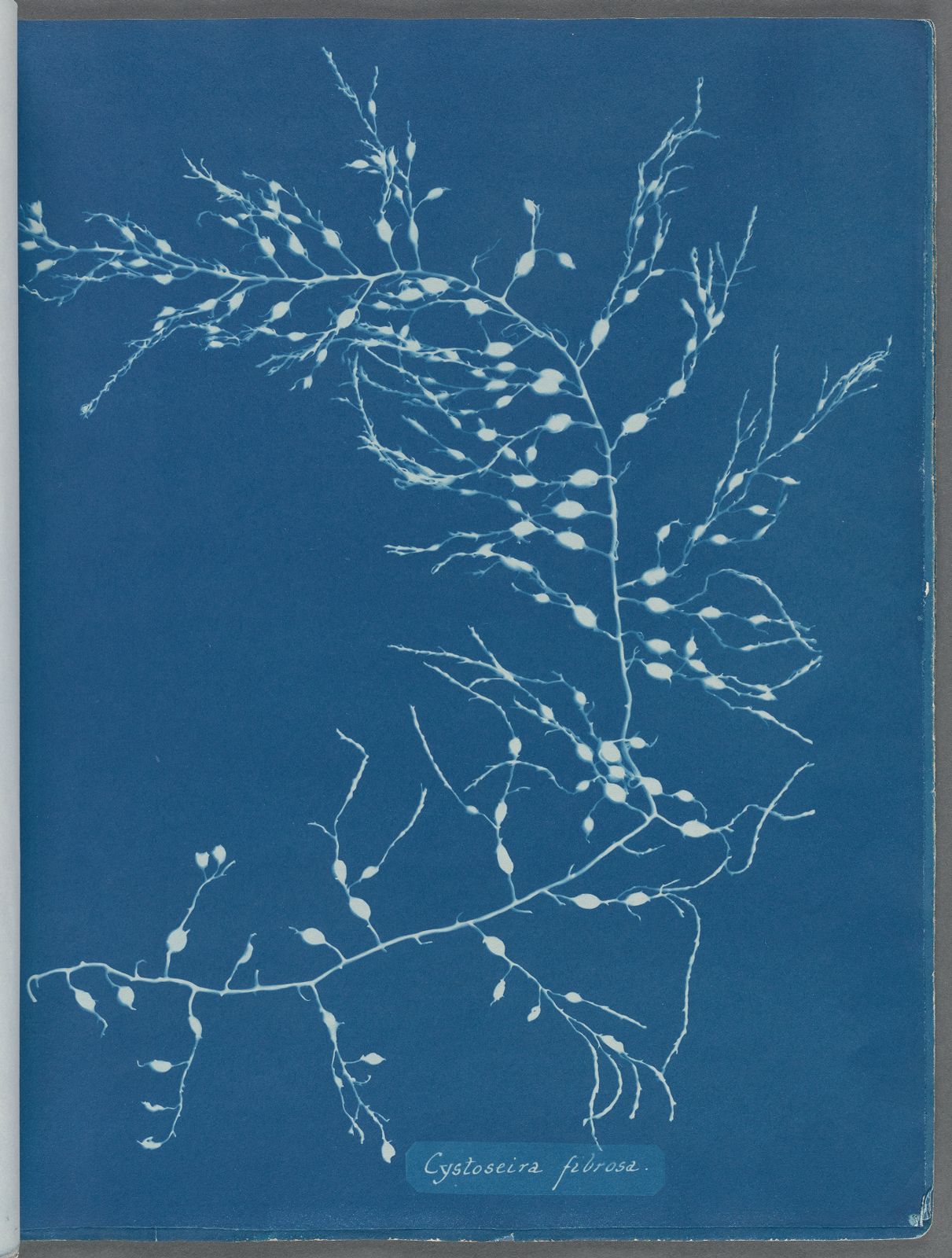
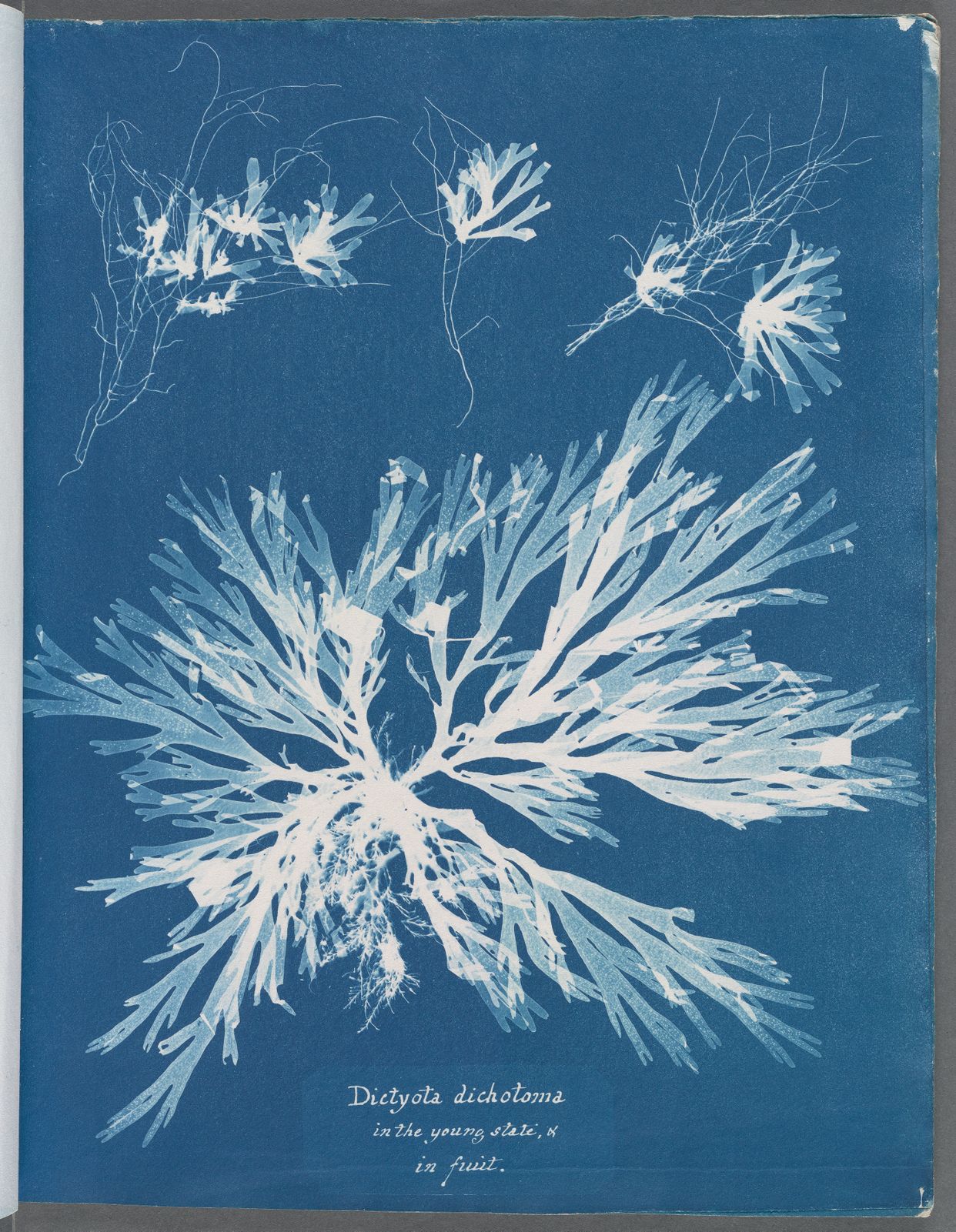
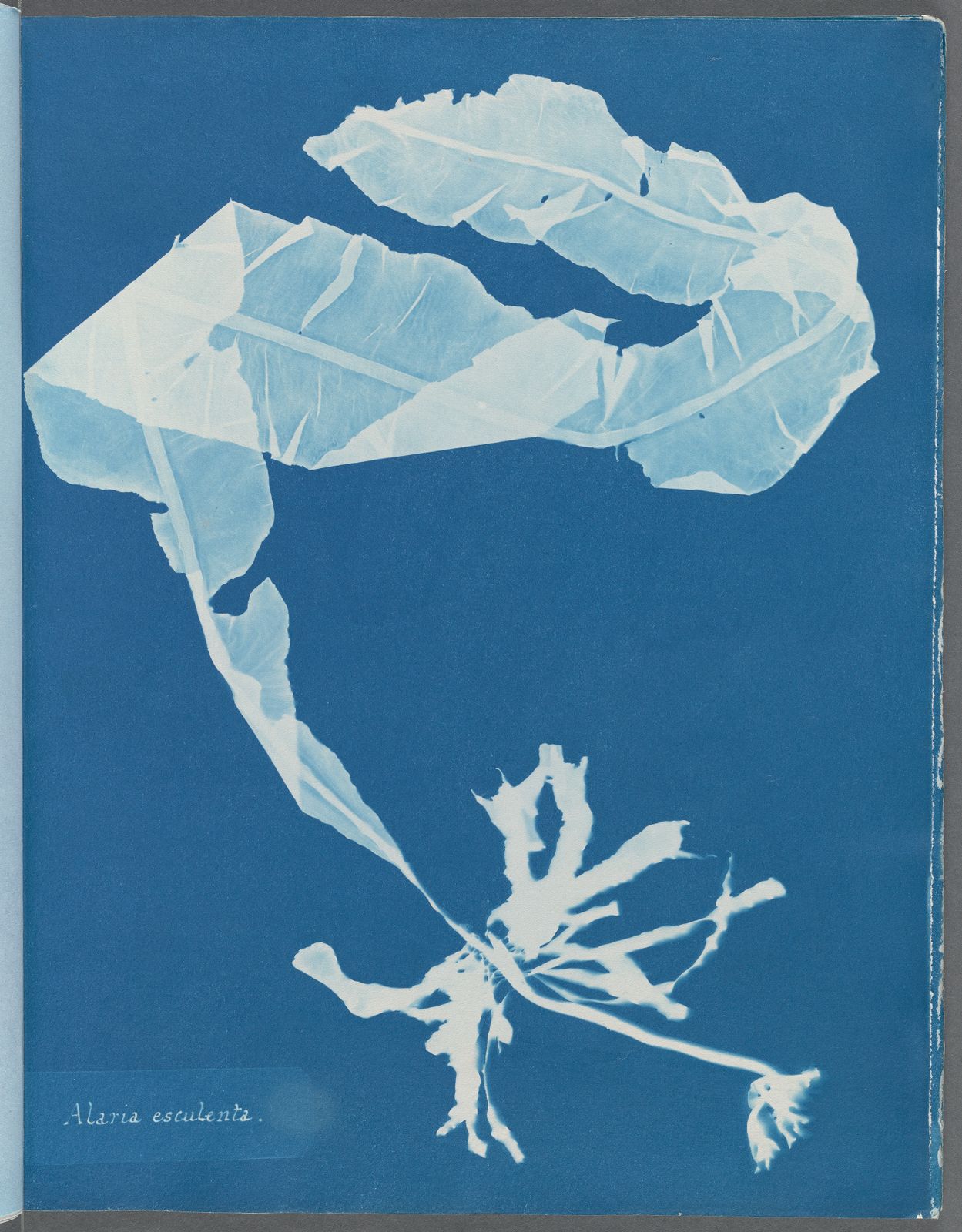
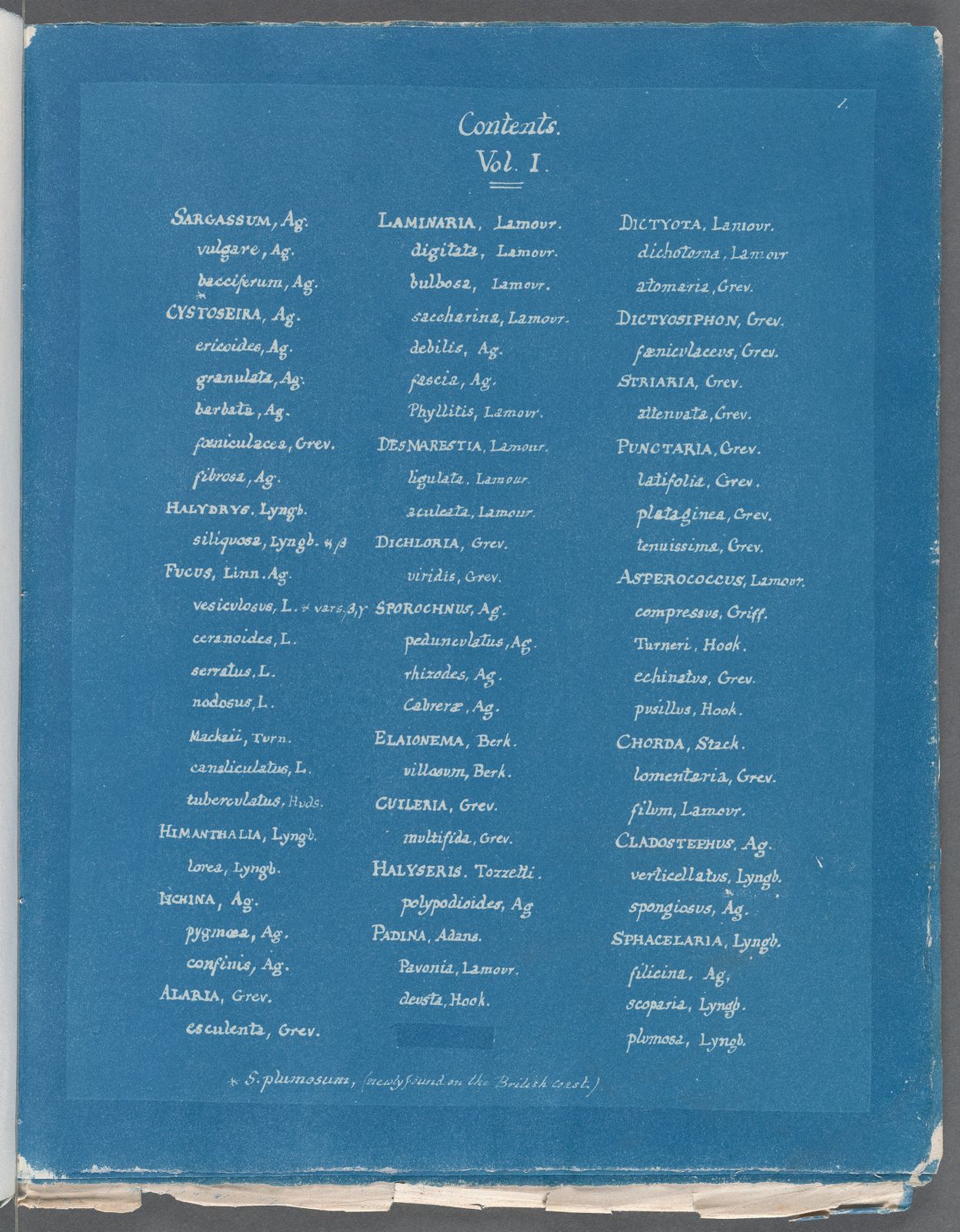
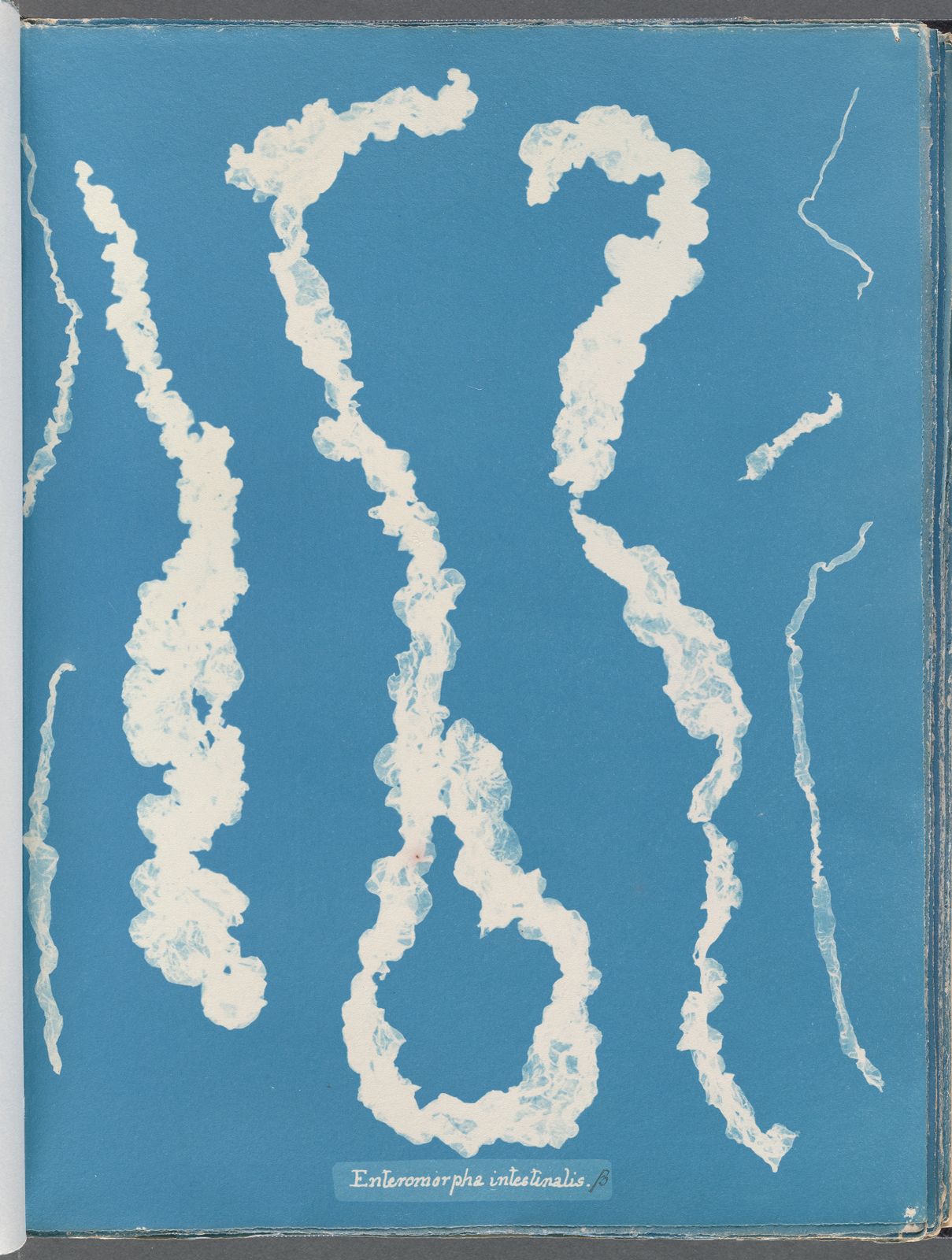
In October 1843, Atkins completed Photographs of British Algae: Cyanotype Impressions, conceived as a visual companion to William Henry Harvey’s Manual of British Algae (1841). To document the specimens it described, she adopted the cyanotype process, developed by her friend and neighbour Sir John Herschel. The technique involves treating paper with a light-sensitive chemical solution, placing specimens directly onto the surface, and exposing it to sunlight, producing a white silhouette against a deep Prussian blue ground. Atkins chose the process deliberately: she sought “to obtain impressions of the plants themselves,” capturing details too minute for accurate hand-drawing.
What resulted was not only a scientific document but a feat of sustained craft. Atkins produced thousands of individual hand-prints across the project, and the first volume alone comprises twelve self-published fascicles. As Lederman notes in What They Saw: Historical Photobooks by Women, 1843–1999 (2021), the work demonstrates a striking aesthetic intelligence — in the arrangement and composition of each plate, and even in the titles, which Atkins rendered directly in cyanotype rather than conventional print. The book is, in this sense, entirely of its medium: an early and sophisticated example of design thinking applied to photographic publishing.
Unlike conventional botanical illustration, which typically presented idealised composites of multiple specimens — smoothing out imperfections and selecting only the most representative features — the cyanotype captured a single plant at a precise moment in time, exactly as it was. Torn leaves, tangled roots, the natural irregularities of an individual specimen: all of it was preserved in the print. Rather than an idealised portrait, each image is an exact impression, a direct trace of something real.
When Henry Fox Talbot described his 1844 publication The Pencil of Nature as the first book of photographic prints, he was mistaken — Atkins had preceded him by at least a year. The distinction matters beyond priority: where Talbot’s book was commercially manufactured and widely distributed, Atkins’s was entirely self-made and self-published. This is precisely what initially worked against her recognition — a privately circulated object without institutional backing — and yet it is also what makes the work remarkable. As Lederman argue, that self-publication is now understood not as a limitation but as a mark of independence and mastery. Her cyanotypes are held today in the permanent collections of MoMA, the New York Public Library, and the Getty, recognised for both their scientific precision and their enduring visual force.
A modern copy of the book can be found through Taschen.
Sources
Franchi, Sophia. “Crafting and Collecting Cyanotypes: Anna Atkins’s Photographs of British Algae: Cyanotype Impressions.” Literature compass 21.1–3 (2024).
Hirschey, Paige. “Rhapsodies in Blue: Anna Atkins’ Cyanotypes.” The Public Domain Review, 6 Dec. 2023, publicdomainreview.org/essay/anna-atkins-cyanotypes/.
Isenogle, Melanie R. Anna Atkins: Catalyst of Modern Photography Through The First Photobook (2019).
Lederman, et al. What They Saw : Historical Photobooks by Women, 1843-1999. 10×10 Photobooks. New York City, 2021.
All images from:
Spencer Collection, The New York Public Library. The New York Public Library Digital Collections.